Most lists of positive affirmations hand you a long scroll of lines and no instructions. You copy five of them onto a board, read them for a week, then catch yourself skipping past. The lines were not yours. Mine were the same: borrowed quotes in a nice font, and by March I walked past the board without reading a word.
What fixed it was not a longer list. It was a three line swap that turns your own complaint into a sentence you believe, plus two numbers: how many lines a board holds, and how many cards fit on one sheet.
I have made a vision board every January for years, and I have rebuilt most of them by spring. The words are the part that fails first.
Quick answer: write three lines, keep one, put it where you look.
- Line 1: the complaint in your own words, including the ugly part.
- Line 2: the part of it that is already true.
- Line 3: the believable version, in the present tense.
- Count: two or three lines on the board, not eight.
- Place: one on the board, one on a card by the kettle, one on your phone screen.
If a line makes you roll your eyes, soften it to “I am learning to” and keep going. For the board itself, a set of Artistic Phrases Printable Sentiments is already sized for a wall, and you write your own line in the blank.
Positive affirmations that sound like you, not like a poster
A poster line is written for everyone. Your line has to survive being read by you, in your kitchen, on a bad morning.
That is the whole test. Here is what the test looks like in practice:
- Present tense: say the line now, not as a promise. “I am steady” works better than “I will be steady”.
- Believable: the line reaches a little past how you feel, but not so far that you roll your eyes.
- Short enough to read in one glance: if you have to track across two lines of text, you will stop reading it by week three.
- Attached to something: a place, an object, a moment in the day.
Everything else in this page is those four rules applied to one spot at a time: the board, the card, the phone, the meeting you dread.
Pro tip: write your lines on paper first, in handwriting, before you set a single one in a font.
A positive affirmation works when it is in the present tense, believable on a bad day, short enough to read in one glance, and attached to a place you already look.
The method for the board itself lives in the vision board guide; this page is only about the words on it, and a sheet like Artistic Phrases Printable Sentiments prints the words at the size a wall needs.
Why affirmations do not work when you do not believe the sentence
Nearly half the conversation about affirmations is not about which lines to pick. It is about the moment the line is read and the mind refuses it.
People describe it in almost the same words every time: repeating a line and then looking in the mirror and seeing the opposite. That is not a motivation problem. It is a wording problem.
A line that clashes too hard with how you see yourself can backfire. A lofty line like “I am a lovable person” can backfire for someone who is feeling low, which is exactly when most people reach for it.
So the strong version is quieter:
| Line type | Example | What happens on a low day |
|---|---|---|
| Verdict | I am completely fearless | Rejected on sight |
| Verdict | I am a lovable person | Can backfire when you feel low |
| Direction | I am learning to trust myself | Often lands better |
| Direction | I am becoming someone calm | Still true while you work on it |
- Instead of a verdict: “I am completely fearless”.
- Use a direction: “I am learning to trust myself”, which often lands better.
- Keep the softener: “I am learning to”, “I am becoming”, “I am getting better at”.
This is the honest negative of the whole practice. Affirmations are not a switch you flip once. Said daily over weeks, they slowly nudge your default self talk in a kinder direction, and that is the actual mechanism. Nothing on the board moves on its own.
I tried the verdict version first, for a full winter, and it made me feel worse every time I read it. The direction version I still have on the wall.
Writing the softer version somewhere other than the board helps, because the page is private. A set of ready phrase cards like Artistic Phrases Printable Sentiments gives you a sentence to react against for the first draft of a line.
How to write an affirmation from your own complaint: the swap in three lines
This is the part no list gives you. You do not need more lines. You need a way to turn your own sentence into one.
Take a notebook, pick the complaint that is loudest today, and write three lines.
- The complaint, raw: “I never finish anything I start.”
- The true part: name what you want to feel or believe instead, and name what is already there. “I finished two of the four things I started this year.”
- The believable line: phrase it in the present tense and keep it believable. “I finish what I start, one thing at a time.”
The table below shows the same shape on four more complaints. Read line three out loud. Say it out loud, and try your own name: using your own name and “you” shifts your perspective, and a line that passes in your own voice is the one that stays on the board.
If it still feels false, you have reached too far. Soften it and write it again. Two minutes, not an evening.
| Complaint | True part | Line you keep |
|---|---|---|
| I never finish anything | Two of four things got finished | I finish what I start, one thing at a time |
| My body is not where I want it | I walked most days this month | I am taking care of the body I have today |
| I freeze in meetings | I said one thing on Tuesday | I am learning to say the thing I came to say |
| Nobody takes my work seriously | One piece went out this quarter | I am doing work I would show to someone I respect |
Pro tip: keep the complaint line in the notebook. When the affirmation goes stale, you rewrite from the complaint, not from a blank page.
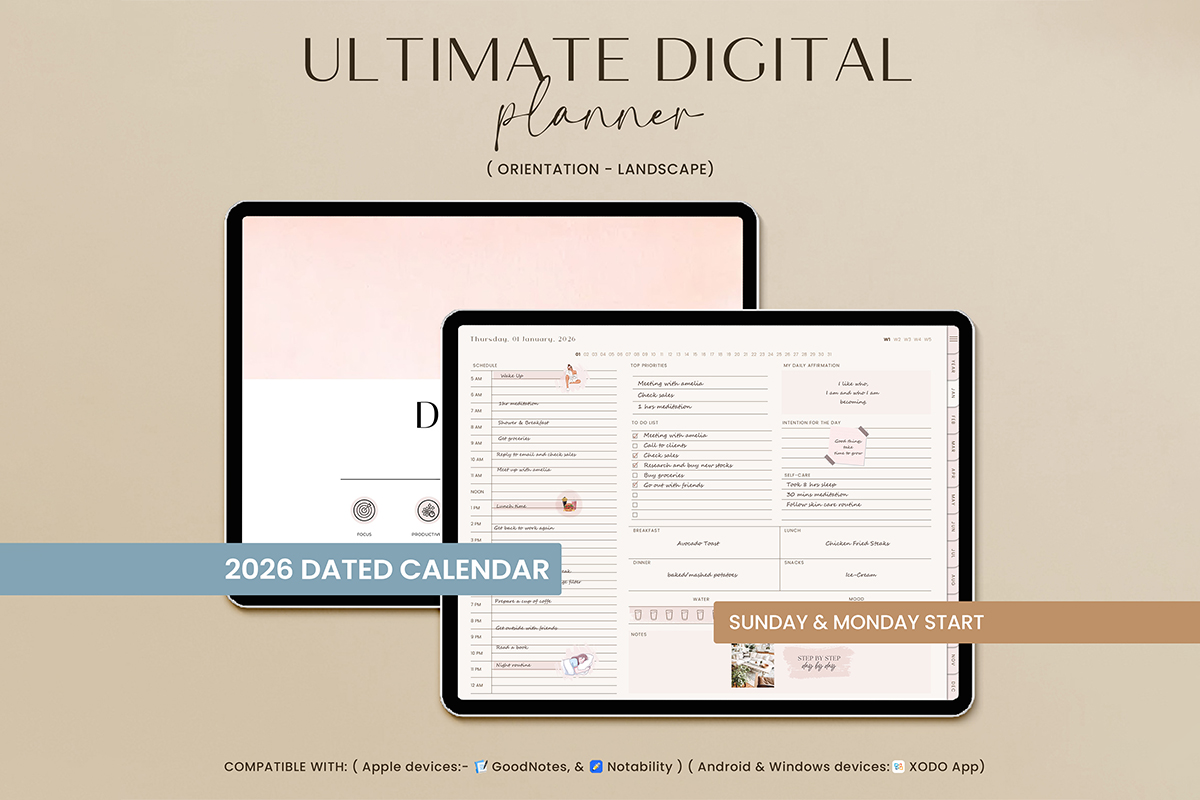
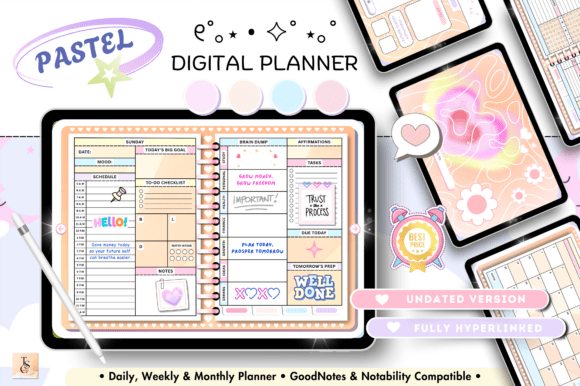
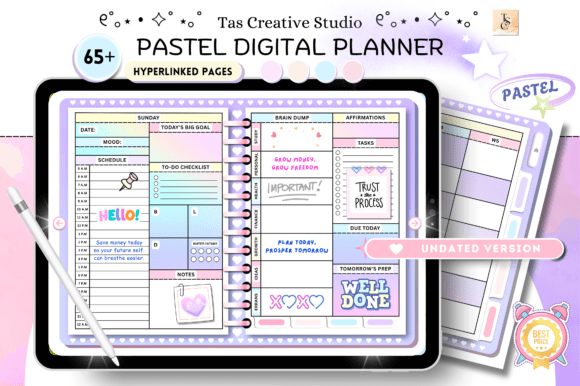
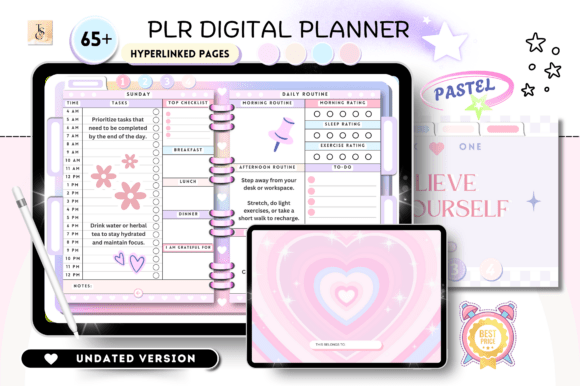
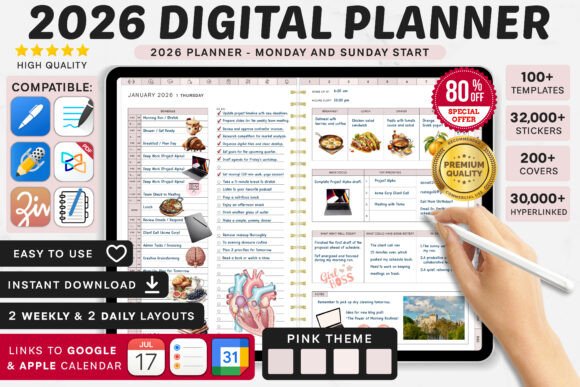
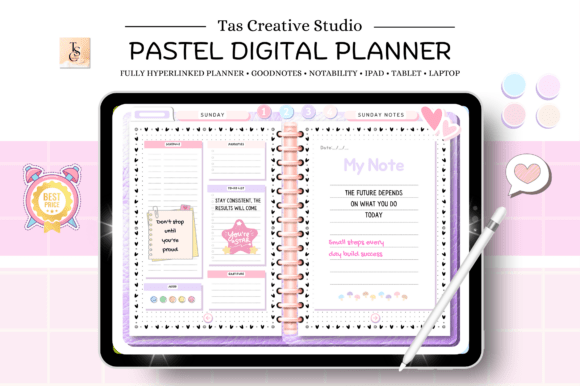
Lined pages make the swap faster than loose paper, and a planner built for it, such as the All-in-One Digital Planner, GoodNotes, keeps the three lines and their dates in one place.
Short affirmations positive enough to survive a glance

A board is read at walking speed. So is a phone screen. Short Affirmations Positive enough to work at that speed are four to six words, which is about one glance.
Lines I use at that length:
- I am steady today.
- I am learning to trust myself.
- I do hard things slowly.
- I keep my own promises.
- I am allowed to start small.
- My pace is still progress.
- I am becoming someone calm.
- I finish one thing at a time.
Long lines are not wrong, they are for a different place: a journal, where you read sitting down. On a wall, a full sentence turns into decoration.
Here is the test: stand three steps back from where the line will hang. If you cannot read it without leaning in, cut words until you can.
Short lines also fit a planner margin, which is where mine live between boards: a weekly page from the All-in-One Digital Planner, GoodNotes holds one line per week.
Daily positive affirmations: the moment of the day that keeps them alive
Daily Positive Affirmations fail on timing more often than on wording. There is no magic number of lines and no magic hour. The best time is whenever you will actually remember.
Which means you attach the line to something you already do:
- Kettle: a card propped against it, read while the water boils.
- Bathroom mirror: one line, taped at eye height, read while you brush your teeth.
- Lock screen: the line on the phone, which you see dozens of times anyway.
- Car keys: a line on the hook, read on the way out.
Two or three that fit your day beat a long list you rush through. Consistency matters more than volume, so a short list you read for six weeks beats twenty lines you abandon in nine days.
What I do now: three lines a quarter on one page, each with the date in the corner, so I can see how long a line lasted.
A planner page is the easiest home for that log, because a board has no room for dates. A set of ready phrase cards like Artistic Phrases Printable Sentiments gives the line a card, dated on the back.
Positive self affirmations: name what you already did
Positive Self Affirmations are where the eye rolling usually starts, because self worth lines are the ones most likely to clash with how you actually feel.
The fix is to build the line on evidence instead of on a claim.
- Claim: “I am enough.” Evidence line: “I kept going when it would have been easier to stop.”
- Claim: “I love myself.” Evidence line: “I am learning to treat myself like someone I like.”
- Claim: “I am confident.” Evidence line: “I said the thing in the meeting on Tuesday.”
Name what you want to feel or believe, then look for the smallest thing you already did in that direction and put that in the sentence. The line stops being a performance.
Pair the line with a page where you write what you did that week. A self care or journalling set, such as the All-in-One Digital Planner, GoodNotes, has the lined pages for it, and those pages are where next quarter’s lines come from.
Health affirmations positive: tie the sentence to the thing you actually do
Health Affirmations Positive in tone are the ones most often written as a body verdict, and a body verdict is the fastest way to a line you cannot read. “I am slim and healthy” read in front of a mirror does the opposite of its job.
Attach the line to an action instead of to an outcome:
- I walk most days, even when it is short.
- I am learning to eat like someone who sleeps well.
- I drink water before coffee.
- I am taking care of the body I have today.
- I move because it makes the day easier.
Each is true the moment you do the thing, so there is no gap between the sentence and the mirror. Attach them to the kettle, the shoes by the door, the Sunday shop.
Track the habit next to the line. A planner like the All-in-One Digital Planner, GoodNotes includes habit pages, and a ticked row is the evidence your next line gets built on.
Work affirmations positive: the line for the meeting you dread

Work Affirmations Positive enough to use at a desk are narrow. One situation, one line. A general line about success does nothing at nine in the morning on a day with a difficult call.
Write one line per recurring situation:
- Before a meeting: “I am learning to say the thing I came to say.”
- Before sending work out: “This is good enough to show, and I can fix it after.”
- After a mistake: “I am someone who corrects things quickly.”
- In a week with too much: “I finish one thing at a time.”
- Asking for something: “I am allowed to ask plainly.”
Say the line out loud in the corridor, with your own name in it, before you walk in. It sounds strange, and it works better than reading it silently.
Keep these lines off the vision board. They belong on the desk, where the situation happens. A neutral planner such as the All-in-One Digital Planner, GoodNotes sits on a work desk without turning it into a mood board.
Vision board words positive affirmations: how many go on a board and where
This is the question I get most, and no list answers it: how many lines go on a board, and where do they sit.
The counts I work to, on an A2 board with twelve images:
- One anchor line at the top, four to six words, the biggest text on the board.
- Two or three section lines, one per area of life, placed under that area’s pictures.
- Single words for everything else: steady, finish, outside, home. Words are labels, not sentences.
Two or three lines that fit your year beat a long list you rush through, and the same arithmetic holds on a wall. Eight competing sentences read as wallpaper.
Which areas earn a picture at all is a separate question, and it is covered in vision board ideas.
You may be thinking that printing your own words is free, so why buy a sheet of anybody else’s. Fair. The reason is narrow: a printed sheet from a home inkjet in a plain system font looks like a document, and it is the one element people quietly remove by February. A set of Vision Board Words Positive Affirmations that is already set and spaced solves the look, and you still write your own lines in the blanks.
Artistic Phrases Printable Sentiments is the set I cut from for the anchor and the section lines, because the text is already sized for a board rather than for a page of body copy.
Aesthetic positive affirmations: one typeface, one colour, one size
Aesthetic Positive Affirmations are not a separate kind of line. They are the same lines with the design decisions already made.
Three rules keep a board from looking like a ransom note:
- One typeface for every word on the board. Two at most, and the second only for the anchor.
- One colour for text, taken from a colour that is already in your pictures.
- Two sizes: anchor and everything else. A third size reads as a mistake.
Print matte, at full size, not fit to page. Fit to page is why a card comes out of the printer a few millimetres smaller than the one you printed last week, and why a row of cards never lines up.
I learned that the slow way, with a sheet of cards printed on three different evenings and none of them the same width.
Aesthetic also means restraint about the words. A board with three sentences and six single words looks calm. A board with twelve sentences looks like an argument.
If you would rather not set type yourself, a matching card set, such as Artistic Phrases Printable Sentiments, gives you one typeface across the board, the card and the week.
Printable affirmation cards: how many fit a sheet and what holds them up
Search for affirmations and most of what comes back is an app to install. What I wanted was a sheet I could print, cut, and put in three rooms.
The numbers I use for cards:
- Size: postcard size for a card that stands on a shelf, wallet size for a card that lives in a bag or a pencil case.
- Per sheet: two of the large size on an A4 sheet, eight of the small size.
- Paper: heavy card stock for anything that has to stand up on its own.
- Lines per card: one. A card with three lines on it gets read as a paragraph and skipped.
What holds them up matters. A card taped to a cupboard door falls off within a month, and a card that falls off is a card you lose. What works for me:
- A small standing frame on a shelf, so the card is swapped in two seconds.
- A bulldog clip screwed to the wall, one clip per room.
- A pin board, with pins through the top corners rather than the middle.
- Washi tape on all four edges if it has to go on a door, never a single piece at the top.
A page from the Money Manifesting EBook Canva Template prints the line at card size, so you cut rather than lay out. Keep it, print it again in April with different lines circled.
iPhone wallpaper positive affirmations: the screen you see all day

The carrier people see every day is the phone, not the wall, and a board on the wall loses to a lock screen on volume alone.
So make the phone version of the same line:
- One line only, in the lower third of the screen, above the thumb and below the clock.
- Four to six words, because the clock and the notifications already own the top half.
- Light text on a dark photo or dark text on a pale one, tested outside in daylight.
- Change it when you change the board, not more often.
iPhone Wallpaper Positive Affirmations work for the same reason the kettle card works: you are not asked to remember anything. The line is already in the path of something you do.
If your planner lives on a tablet rather than on paper, a set like the All-in-One Digital Planner for GoodNotes keeps the same line on the first page you open each morning.
When a line goes stale: the ten-minute rewrite
Every line I have written has eventually stopped working. That is not a failure of the line. Affirmations are practice, not a switch you flip once, and practice changes shape as you do.
The signs are easy to spot:
- You read the board and your eye skips the words.
- The line has become true, and now it is a statement of fact.
- The line was never true, and reading it has started to annoy you.
The rewrite takes ten minutes:
- Read the old line out loud. Note which of the three signs it is.
- Go back to the complaint you wrote it from, in the notebook.
- Write the complaint as it is today. It has usually moved.
- Write the new line, present tense, believable, soften if it makes you wince.
- Replace the card, the board line and the lock screen in one sitting, so the three agree.
I rewrite at the start of each quarter, and roughly one line in three survives to the next one. That ratio stopped bothering me once I expected it.
If you would rather start from a set of pages that are already laid out, Artistic Phrases Printable Sentiments has the kind of lined cards the three line swap needs.
Before you put a line on the board, confirm:
- It is in the present tense.
- You can read it without rolling your eyes.
- It is readable from three steps back.
- It is attached to a place or a moment, not floating.
- There are no more than three sentences on the whole board.
- The date you wrote it is on the page in your notebook.
Positive affirmations FAQ
| If you are choosing | Take this |
|---|---|
| A number of lines | Two or three, read daily |
| A wording | Present tense, softened to “I am learning to” |
| A length for a board | Four to six words |
| A card size | Postcard size on a shelf, wallet size in a bag |
| A time of day | Whenever you will actually remember |
| A rewrite rhythm | Once a quarter, from the original complaint |
What are positive affirmations?
Short sentences in the present tense that name what you want to feel or believe, read often enough that they shift your ordinary self talk. On a board they work as labels for a direction, not as spells.
Do affirmations work?
They work as practice, not as a switch you flip once. Said daily over weeks, they slowly nudge your default self talk in a kinder direction, which is a slow change rather than an event.
Why affirmations don’t work
Most often because the line clashes too hard with how you see yourself, and a line like that can backfire. A lofty sentence read on a low day gets rejected on sight. Soften it to “I am learning to” and it lands.
How many affirmations should I use
There is no magic number. Two or three that fit your day beat a long list you rush through, because consistency matters more than volume.
What do I write on a vision board
One anchor line of four to six words, two or three section lines placed under the pictures they belong to, and single words everywhere else. Keep the total under three sentences, and if you want the type already set, cut the lines from a sheet such as Artistic Phrases Printable Sentiments.
How often to rewrite an affirmation
When your eye starts skipping it, or when it has become plainly true. In practice that is about once a quarter, and the rewrite starts from the complaint you first wrote the line from.
What makes a good affirmation?
Present tense, believable, short, and attached to something you already do. It should reach a little past how you feel, but not so far that you roll your eyes.
Are self-affirmations best said every day?
Daily helps, but the hour does not matter. The best time is whenever you will actually remember, which is why the line goes next to the kettle or on a lock screen.
Can affirmations be negative?
A line can work against you if it contradicts your self image too sharply. Repeating “I am a lovable person” can backfire for someone feeling low, while “I am learning to trust myself” often lands better.
Can affirmations rewire your brain?
Not on their own, and claims about how affirmations change the brain or affect the subconscious mind go further than anything you can check. Said daily over weeks, they slowly nudge your default self talk in a kinder direction.
How do affirmations help, and how did they change my life?
They help on ordinary days. People say affirmations changed their life or shift their energy; what shifts first is the tone of the words you use about yourself.
What affirmations should I use, and what are affirmations examples?
Use lines you wrote from your own complaint. Examples sit in every section above: one for health, one for work, one for a relationship, one for money and one for manifestation style goals, all built the same way.
Why are affirmations important, and why are they sometimes bad?
They are important because they change the sentence you repeat by default, which is powerful over weeks. They are bad when the line clashes too hard with how you see yourself.
Are the best affirmations for women, men, kids or self love any different?
No. A list for women, men or kids, a self love list, a success or manifesting list, a money list and an app of lines all fail the same way if the line is not yours.
Do affirmations work, going by what people say on reddit?
Threads about affirmations circle back to one complaint: the line is not believed. Softening it to “I am learning to” is the fix people land on, and the softened line fits a wider practice, like the one in the Money Manifesting EBook Canva Template.
Should I say affirmations out loud?
Yes, and try your own name in the sentence. Using your own name and “you” shifts your perspective, and a line that survives being said aloud is a line worth printing.
Key takeaways
The whole method fits in a short list you can work through tonight.
- Write the complaint, the true part, and the believable line. Keep the third one.
- Put every line in the present tense, and soften anything that makes you wince.
- Hold the board to one anchor line, two or three section lines, and single words after that.
- Keep board lines to four to six words so they read from three steps back.
- Print cards at postcard size on heavy paper, two per sheet, one line per card.
- Clip or frame the cards instead of taping a top corner.
- Attach each line to something you already do: the kettle, the mirror, the lock screen.
- Rewrite once a quarter from the original complaint, and expect most lines not to survive.
For the dates and the rewrite log, a sheet like Artistic Phrases Printable Sentiments sits beside the board, and a tablet version lives in the All-in-One Digital Planner, GoodNotes.
The method for the board itself is in the vision board guide, and the about page explains who writes these pages.